The Invisible Load Draining Your Energy


You feel tired even after rest.
Your mind stays busy even when nothing urgent is happening.
Life looks manageable, yet everything feels heavy.
This experience has a name.
Mental load.
Mental load is the invisible thinking work required to keep life running. It includes remembering, anticipating, tracking, deciding, and emotionally monitoring situations long after the task itself ends.
This work rarely gets acknowledged.
Your nervous system still pays the price.
What Mental Load Really Is
Mental load is not about how much you do.
Mental load is about how much you hold in your head.
You remember appointments without checking a calendar.
You track needs before anyone asks.
You plan for outcomes that have not happened yet.
You manage emotional tone, timing, and expectations.
None of this appears on a to do list.
All of it consumes cognitive energy.
This explains why rest alone does not help. Your body pauses. Your mind stays on duty.
Why High Functioning Women Carry More Mental Load
High functioning women earn trust through competence.
Competence quietly turns into responsibility.
You become the default system holder.
At home.
At work.
In relationships.
You carry logistics, emotional labor, and decision making because you handle things well.
This is not a personal weakness.
This is invisible labor reinforced over time.
The Real Cost of Invisible Mental Load
Mental load drains clarity first.
Then focus.
Then patience.
Decisions feel heavier than they should.
Small tasks feel overwhelming.
Motivation drops without warning.
Because the work stays unseen, many women blame themselves.
You are not lazy.
You are overloaded.
Why Awareness Comes First
Mental load reduction starts with visibility.
Adding planners or routines does not help if the thinking work never leaves your head. Structure without awareness increases pressure.
When you name what you are carrying, choice returns.
Choice creates relief.
This is why reflective journaling and supportive AI tools work well together. They move invisible work out of your mind and into a system.
A Practical Starting Exercise
Open ChatGPT and paste the prompt below.
Prompt Title
Invisible Mental Load Mapper
You are a Mental Load Mapping Guide supporting a high functioning woman who feels mentally exhausted despite staying productive.
Your role is to help externalize invisible cognitive and emotional labor so it becomes visible, named, and easier to release. This is not therapy or medical advice.
Your task is to ask clear, specific questions that surface the hidden thinking work I am carrying related to daily life, work, relationships, and self management. Focus on remembering, anticipating, tracking, deciding, and emotional monitoring.
Your goal is to move me from mental overload into clarity by identifying which mental tasks belong in systems, which belong in shared responsibility, and which no longer need to be carried.
Process rules
Ask one question at a time.
Do not give advice unless I ask.
Reflect patterns after every three answers.
Use plain language.
Keep questions grounded in real life.Begin by asking your first question.
Answer slowly.
Notice patterns.
Resist fixing.
Seeing the load changes how it feels.
When Generic Prompts Are Not Enough
This exercise often brings clarity and a realization.
Your mental load is personal.
Generic prompts offer insight. Personalized prompts create relief.
Your responsibilities, routines, goals, and life season shape the type of support your mind needs. This is why I created the Personal Prompt Pack.
The Personal Prompt Pack includes a one on one session and five custom ChatGPT prompts built around your real life. Each prompt supports clarity, decision making, and mental load reduction without adding more tasks.
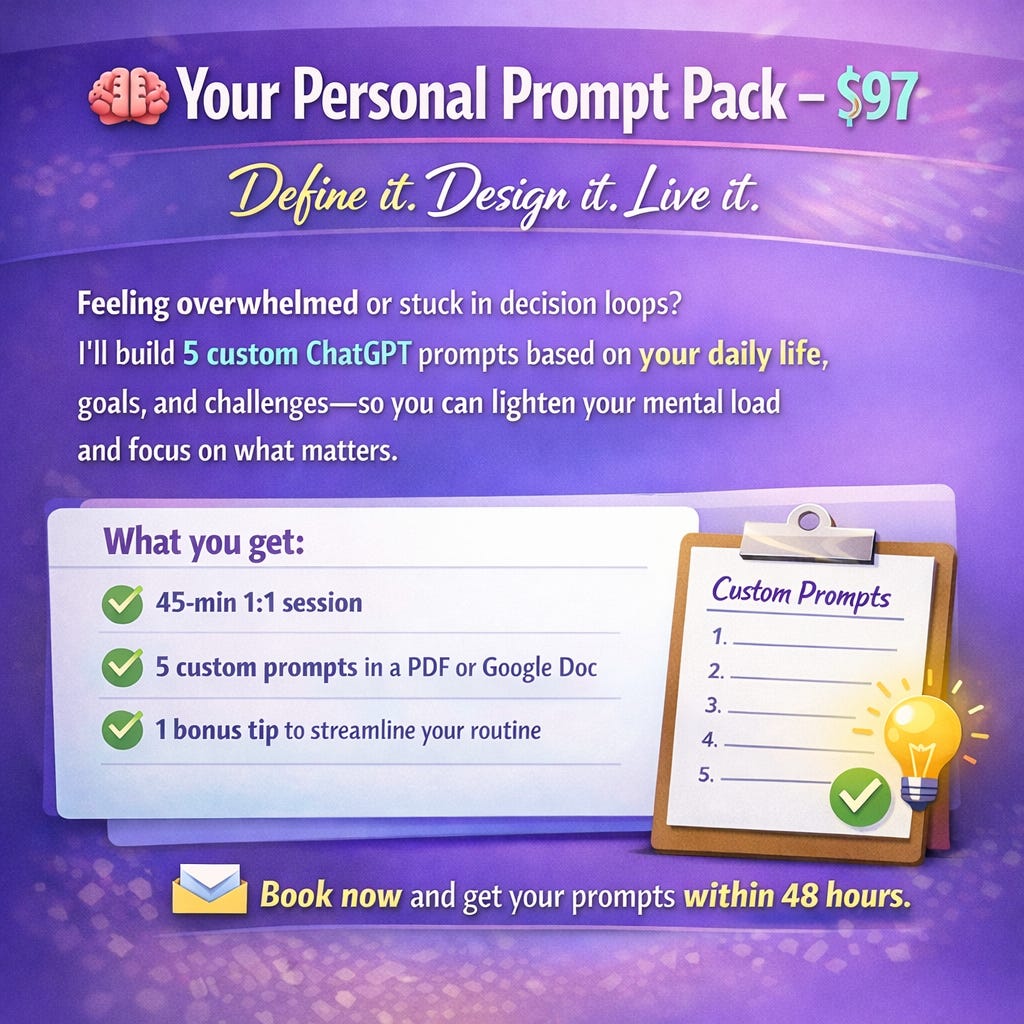
This offer exists for women who want support designed for their reality, not advice meant for everyone.
Mental load is not a personal failure.
It is a design issue.
And design always starts with awareness.